
Adams County VINELink Coverage
Idaho VINE is the statewide custody-information and notification service managed by the Idaho Sheriffs' Association with Appriss. The association describes interfaces with Idaho jail booking systems and the Idaho Department of Correction. It also describes a court-notification link with the Idaho Supreme Court. Adams County makes this channel especially relevant because the Sheriff's official page links VINELink under the label “Victim Notification System.” The county does not publish its own searchable recent-release feed.
Coverage does not turn VINELink into one merged custody record. A county detainee's entry comes from a jail contributor. An IDOC resident or client may have a state record. The live agency name is essential because release from one contributor can be followed by transfer to another. Someone who leaves Adams County Jail for IDOC has left the county building's custody, but is still confined if IDOC reports “In custody.” Conversely, an IDOC status of “In community” means prison confinement ended while state supervision may remain.
Search One Adams County Person
Start with the Idaho person search, not a general web result. Use the exact legal name when known. An agency or person identifier can narrow the match. If several people have similar names, compare the identity details and contributing agency before opening or saving a record. Do not assume every person once booked in Adams County will remain in the live results forever. Dynamic wording and retention can change.
- Open the Idaho-specific VINELink person search and enter the person's name or available identifier.
- Review all close matches. Compare the shown identity data instead of choosing solely by name.
- Open the likely record and identify the contributing jail or IDOC agency before reading status.
- Read the status and event language together. Note whether it reports release, transfer, escape, return, or another custody change.
- If no sound match appears, retry alternate name forms, check the proper jurisdiction, and contact the jail or IDOC.
A no-result screen is not evidence of release. The spelling may differ, the record may belong to another agency, or the contributor may no longer expose it. For a county event, call Adams County Jail. For a state case, search IDOC by last name or IDOC number. The broader Adams County released-inmate search paths explain how sheriff, court, and state records fit together.
The official search interface is shown in the following capture from the Idaho VINELink person-search source.
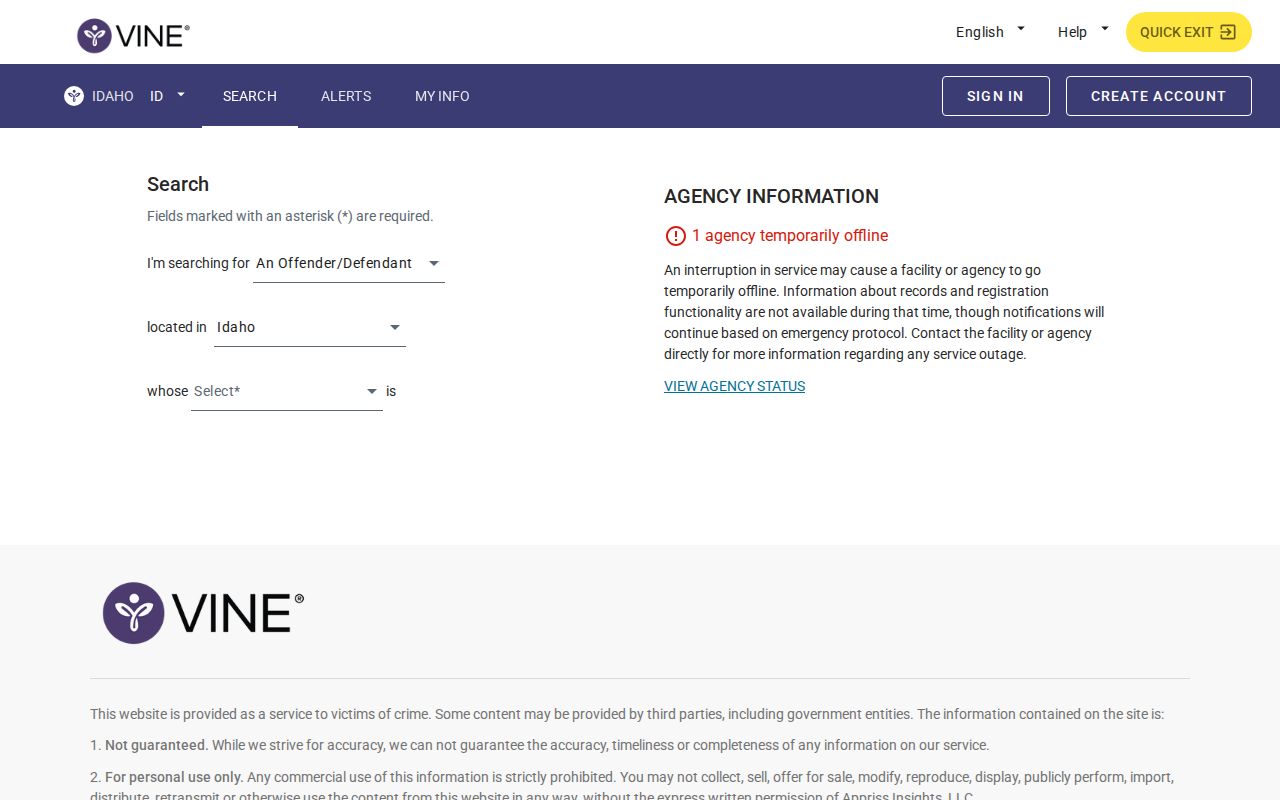
The screen is the starting point only. A reliable result still depends on choosing the correct person and agency record.
Read Adams County Release Results
VINELink is most useful when its fields are read as a small evidence set. The exact labels can change, so no fixed “released” field should be promised. Save the timestamp and message when an alert arrives. Then record the agency, status, and event wording. These facts tell which office can confirm the next step.
| Result element | What it establishes |
|---|---|
| Person and identifier | Helps distinguish the named record from another person with a similar name. |
| Contributing agency | Identifies the jail or IDOC source whose custody changed. |
| Custody status | Reports the current state of that contributor's live record, subject to update timing. |
| Event wording | May distinguish release from transfer, escape, return, or another change. |
| Notification time | Shows when the service sent the alert, not necessarily a certified jail-exit time. |
A county release message does not explain the court outcome on its own. The Adams County criminal docket can show dismissal, judgment, sentence, or probation. A targeted sheriff booking/release record is the better source for exact exit time and release authority. State cases require a separate IDOC review for status, supervision, and discharge evidence.
Set Adams County Release Alerts
Registration must be attached to the correct live record. Current controls may read “Get Notified” or “Notify Me of Status Changes.” Available channels can include phone, email, text, or a combination. For phone registration, create a four-digit personal identification number, or PIN. IDOC says its VINE calls repeat every two hours for 48 hours until the PIN is entered. That PIN confirms receipt and stops the repeat-call cycle.
- Open the verified person and agency record, then choose the notification option.
- Select each available channel that fits, such as phone, text, or email.
- Enter the destination carefully. For phone alerts, create and retain the four-digit PIN.
- Continue to the confirmation screen, review the person and agency, and submit the registration.
- When an alert arrives, save its time and wording before verifying the event with the source agency.
The IDOC victim-services page documents the state alert channels and phone-call confirmation process.
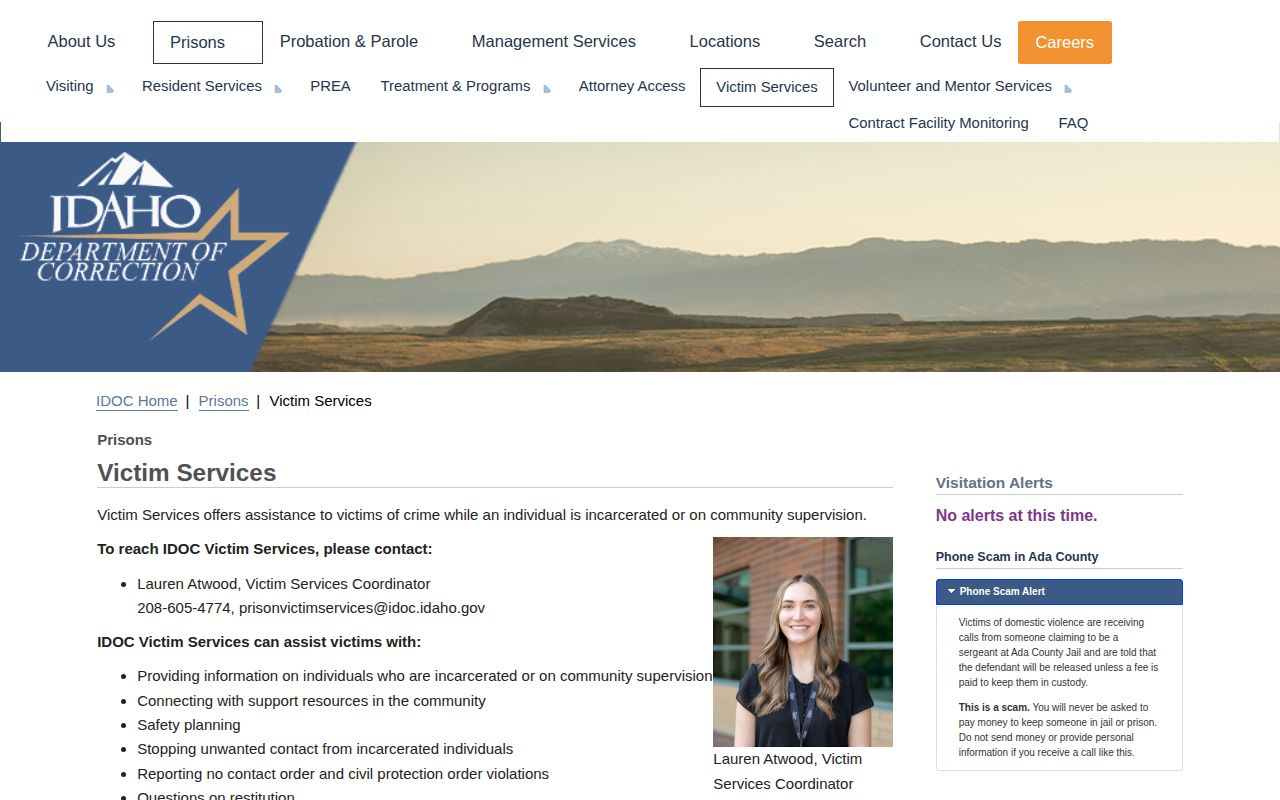
This state guidance is relevant to IDOC-linked alerts. A county jail event still needs confirmation from Adams County Jail.
Why Adams County Relies on VINE
Adams County's official web navigation does not offer a recent-release roster, archived booking list, or named-person jail search. Yet the Sheriff directly points to VINELink. That makes VINE the county's clear public notification layer, not an unofficial substitute discovered elsewhere. The Idaho Sheriffs' Association supplies the statewide interface that connects jail booking systems and IDOC.
The arrangement helps with a known person, especially when a family member or case participant needs notice of a change. It cannot produce a complete list of everyone released in a given day. It also cannot replace an official copy of the booking and release transaction. When exact proof matters, identify the person and date range on the Sheriff's public-record request form and ask for existing records.
The statewide role is illustrated by the Idaho Sheriffs' Association VINE page.
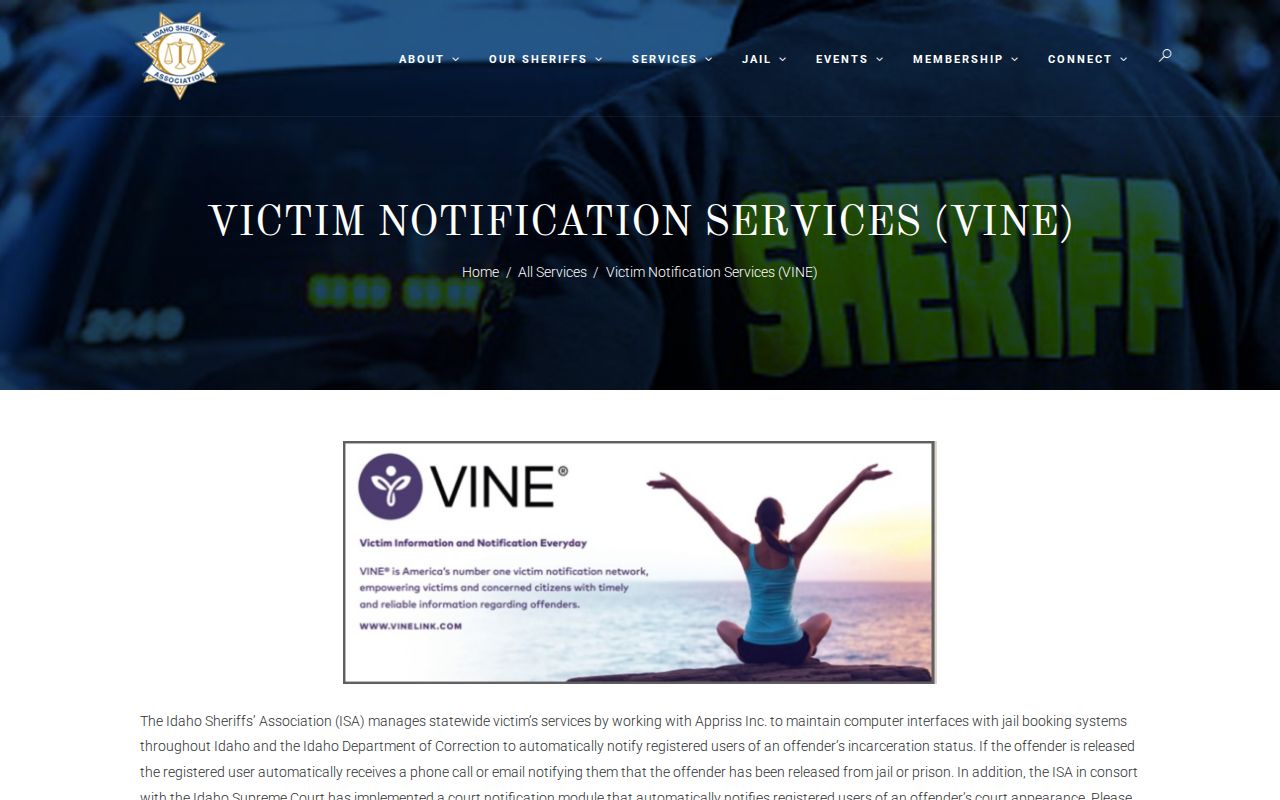
Its coverage statement explains why the contributing agency must be checked for every Adams County result.
Confirm Adams County Release Events
After a county alert, contact Adams County Jail and inspect the Adams County court case. Ask whether the event was a community release or a transfer. A transfer destination matters because a receiving jail, IDOC, federal authority, medical setting, or other custodian may still hold the person. VINE is event-driven, while a court entry follows docket timing and the IDOC public search updates daily. Small differences in time are expected.
For an IDOC event, use the Resident/Client Search and read the state status. “In community” can include a release-to-supervision date, district, and officer. “Discharged” marks the displayed end of IDOC jurisdiction. Neither status should be replaced by a guess based on a VINE notice. District 3 handles state community supervision for Adams County.
Idaho VINE is not a federal locator. Use the Bureau of Prisons locator for a federal sentenced person and federal VNS for eligible federal notifications. Use ICE's detainee locator for immigration custody. ICE may retain a released entry for a limited period, and its release wording can include removal or transfer. Each system answers a different question.
When Adams County VINE Fails
Begin with the jurisdiction that last held the person. Adams County Jail can confirm whether its own custody ended and whether a transfer occurred. A narrow Sheriff records request can seek the booking sheet, admission and release timestamps, release authority or code, and a transfer destination if that field is disclosable. Ask for existing records rather than a new narrative report.
If the case moved into state custody, search IDOC by last name or IDOC number. Partial search accepts the first two characters of a last name or the first three IDOC digits. Check status, location, county and case information, and any supervision or discharge fields. For the legal result, iCourt may show the Register of Actions, judgment, sentence, dismissal, probation, or discharge entry.
These channels complement one another. The jail record documents physical custody, the court explains legal authority, and IDOC documents state jurisdiction. A release is strongest when two sources agree.
Keep the time limits of other systems in mind. The Bureau of Prisons locator covers federal sentenced-custody records from 1982 forward. ICE's locator has a much shorter view for people released from immigration custody. Neither window describes Idaho VINE retention. A no-result response must always be interpreted within the system searched.
For personal records, note the spelling used, search time, jurisdiction, agency name, status, and event text. Those details make a later call more precise. They also help separate an initial VINE notice from a later official correction. Do not treat an alert screenshot as a substitute for the originating booking or discharge record.
Adams County Court Cross-Check
The Adams County criminal docket supplies legal context that VINE does not. A Register of Actions may show charges, dismissal, judgment, sentence, probation, warrants, or a later discharge entry. Those events can explain why custody should change, yet a docket entry does not always record the exact moment someone physically left the jail.
Match the court case to the same person and booking. A dismissal can support the reason for release, while the Sheriff's ending transaction supplies the release time. A probation order may show that confinement ended but court supervision began. If IDOC controls the sentence, the state detail and District 3 record remain necessary. This two-source method reduces the risk of confusing a legal order with its later operational completion.
Save Adams County Alert Details
Record the full alert before making calls. Note the person's displayed name, contributor, event, message time, and any identifier. If a phone notice repeats, enter the registration PIN only after recognizing the correct record. A saved email or text can help agency staff understand which event prompted the question.
Ask a precise follow-up: did Adams County custody end through community release, or did another authority receive the person? If the answer is transfer, request the destination when it is disclosable and search that system. This simple distinction prevents an agency-specific alert from being stretched into a claim about all custody.