
Adams County Projected Versus Actual
A projected date is a forecast or legal milestone. Actual release is a completed custody transaction. Idaho public records expose three dates that are often confused. A Parole Eligibility Date is the earliest point at which parole may be considered. A Tentative Parole Date is a conditional Commission target after a grant. A Sentence Satisfaction Date is the shown endpoint of the sentence. None proves that the person walked out of a facility.
A pretrial Adams County Jail detainee usually has no computed prison release date. Bond may be posted, a judge may change the order, charges may be dismissed, or another agency may take custody. Even a jail departure can be a transfer rather than a community release. The Sheriff's booking/release transaction and court docket are the proper sources for that local event.
Find an Adams County Date
Start with legal custody, not physical location. The Idaho Department of Correction may place a state resident in a contract bed identified as “Contract Adams County Jail 1.” If IDOC reports “In custody,” the person remains in state custody even though the building is the county jail. Ordinary county bond-outs may never appear in IDOC at all.
- Search the IDOC Resident/Client Search by last name, optional first name, or IDOC number.
- Compare the name, birth year, IDOC number, status, county, and case details.
- Open the correct detail and distinguish Parole Eligibility, Sentence Satisfaction, next-hearing, and any release-to-supervision fields.
- Check Commission decisions if parole action applies, but treat a tentative date as conditional.
- Confirm the completed event through updated status, VINELink notice, District 3, or the source facility.
For a county-only case, call Adams County Jail and review iCourt. A narrow records request can seek admission and release timestamps, the release code or authority, and transfer destination if disclosable. The Adams County release-record paths show how those local sources connect.
The following official example comes from an IDOC detail record with date fields.
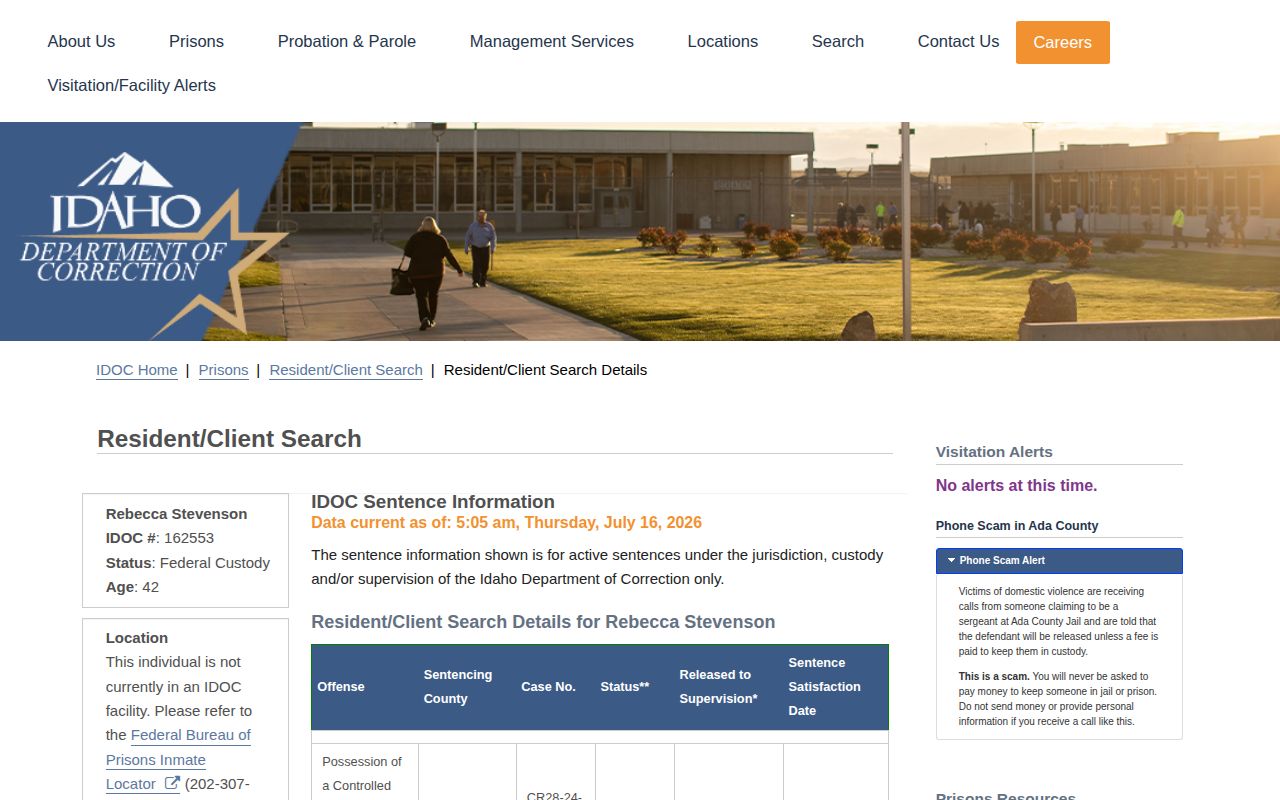
It demonstrates that the fields coexist and must be interpreted separately, not that the example person has an Adams County connection.
Idaho Fixed Terms Shape Release
Idaho has no verified blanket rule that every prisoner serves 85 percent. Under Idaho Code § 19-2513, the sentencing court specifies a fixed or minimum term and may add an indeterminate term. During the fixed term, the person ordinarily is not eligible for parole, discharge, or routine reduction for good conduct. Multiplying the full sentence by a set percentage therefore gives a misleading Adams County projected release date.
The first ordinary parole-eligible date accounts for the fixed term, credit for time served, and the sentence structure. Concurrent terms run together, while consecutive terms run one after another. Multiple cases, mandatory minimums, amended judgments, and corrected credit can change the calculation. The IDOC Timely Release Report explains that those components feed the first eligibility date.
- Fixed term
- The judge-set period served before ordinary parole eligibility.
- Indeterminate term
- The portion during which parole may be possible, subject to Commission discretion.
- Credit for time served
- Qualifying custody time credited in the sentence calculation.
- Discharge
- The end of the displayed IDOC sentence or jurisdiction, not merely release from prison.
Why Adams County Dates Move
Even a valid date can change before release. The Commission may grant parole yet wait for programming, investigation of the release plan, transport, final paperwork, a contract, and the person's signature. It may also modify or rescind action. Sentence data can be corrected, and a new case or hold can alter what happens at the gate.
| Factor | Effect |
|---|---|
| Programming | Incomplete required work can delay a tentative parole date. |
| Parole plan | A rejected or unfinished investigation prevents release on the target date. |
| Commission action | A grant, denial, continuance, modification, or rescission changes the forecast. |
| Sentence correction | Credit, concurrent or consecutive structure, or judgment changes can recalculate dates. |
| Other authority | A detainer, meaning another agency's hold, can lead to transfer instead of community release. |
| County court event | Bond, dismissal, time-served calculation, or a new order controls a local jail exit. |
Confirm Adams County Actual Release
Register for an agency-specific alert through the Adams County VINELink Release Check. After a notice, identify whether the event is release, transfer, escape, return, or another status change. A county event should be checked with Adams County Jail and the court docket. A state event should be checked through IDOC and, when supervision follows, District 3.
Actual state release may appear as “In community” with a Released to Supervision date and supervising district. Full sentence completion may appear as “Discharged” with a date. The public search updates daily rather than in real time, so the source facility can be ahead of the web record. A parole grant or tentative date alone never completes the proof.
Idaho Extraordinary Credit Is Rare
Idaho Code § 20-101D is not ordinary earned time. It permits a director's award for extraordinary conduct such as a heroic act risking the person's life, outstanding service that saves lives, prevention of major property loss during a riot, or prevention of escape. The reduction cannot exceed 15 days for each month sentenced and can be withdrawn under agency rules.
Routine rule compliance or program attendance should not be described as earning this credit. Medical parole under § 20-1006 is also an exceptional route governed by its own conditions. Neither provision supports a simple online release-date calculator. Adams County dates must come from the actual judgment, IDOC calculation, and current Commission action.
Adams County Parole Forecast Limits
The Idaho Commission moved to weekly schedule posting in April 2026, yet hearing order is not posted until the prior day and dates may change. Its decisions page generally posts a Notice of Action Taken after the hearing. Decision records can include the date, IDOC number, name, meeting type, result, next hearing, and Tentative Parole Date.
A tentative date remains a forecast. The person must finish prerequisites, obtain plan approval, resolve transportation, complete the contract, and sign. The Commission states that no one releases before the displayed tentative date. That statement sets an earliest boundary, not a promise that release occurs that day.
Adams County Jail Date Rules
County jail release dates arise from the local case and custody transaction, not from IDOC's prison fields. Bond posting may lead to a pretrial release. A dismissal or judge's order may end the basis for confinement. A misdemeanor sentence may end through completion or a time-served calculation. Another authority may instead receive the person. No Adams-specific county good-time, weekend-release, or holiday-release rule was found, so none should be inferred.
The Sheriff's record should identify admission and release timestamps, the ending code or authority, and a transfer destination when that field is public. iCourt can explain the judgment or order. These records may post at different times. If the person disappears from county visibility, check whether IDOC now shows “In custody” before calling the event a release.
Physical location is not enough. An IDOC record has shown “Contract Adams County Jail 1,” proving that state jurisdiction can exist inside the local facility. Legal custody controls which date system applies.
Read Idaho Commission Decisions
The Commission publishes hearing schedules and Notices of Action Taken. Outcomes include grants, denials, continuances, modifications, revocations, and decisions passing a person to the full-term date. Read the exact outcome. “Grant Parole” does not equal release, while “Deny and Pass to Full Term Release Date” points toward sentence completion rather than an earlier parole target.
The Parole Eligibility Date coincides with the start of the indeterminate portion under the Commission's description. For multiple sentences, the latest relevant indeterminate-begin date controls. Eligibility is only an opportunity for consideration. It creates no right to release. Medical parole and final discharge follow separate statutes and findings.
After the Commission acts, return to IDOC. A completed release to parole should produce current community-status evidence and supervision detail. If the public record remains “In custody,” the forecast has not yet become a confirmed state release.
Adams County Release Evidence
Use a small evidence chain for the final answer. First, record the predicted field and its label. Second, look for the agency decision that authorizes or changes the date. Third, find operational proof after the date passes. For a county case, that proof is the jail release transaction. For a state case, it may be an updated IDOC status, Released to Supervision field, and District 3 confirmation.
VINE can provide prompt notice, but the event remains tied to its contributing agency. A release alert from one jail cannot rule out a transfer. Court entries establish legal context but may not show the precise exit time. Combining the correct sources is more reliable than repeatedly checking one forecast field.
Sentence Satisfaction Is Different
A Sentence Satisfaction Date represents the endpoint shown for an active IDOC sentence. It can be later than the first parole opportunity because parole allows part of a sentence to be served in the community under conditions. Full-term release and final discharge must also be read in their precise context. A person may leave prison before satisfaction while remaining subject to IDOC supervision.
Idaho Code § 20-1012 governs final discharge after parole. The Commission may grant final discharge after satisfactory performance, ordinarily not before one year on parole, and must discharge by maximum expiration when an earlier discharge is not granted. This is another reason a prison exit date and end of jurisdiction cannot be treated as synonyms.
For Adams County, District 3 supervision fields help connect an “In community” record to the responsible state office. Local adult probation at the county courthouse is separate. The judgment or IDOC detail identifies which authority applies.