
Adams County IDOC Release Status
IDOC jurisdiction can end in two distinct ways. A person paroled from prison may appear as In community
, with fields for the supervising district, officer, offense, case, supervision type, Released to Supervision, and Sentence Satisfaction Date. That person has left prison but remains under an IDOC sentence. A record marked Discharged [date]
shows the date state correctional jurisdiction ended.
Other exact labels require care. In custody
means confinement continues. Active Bench Warrant
and Fugitive
are active warnings, not routine release outcomes. Federal Custody
and Deported
identify different jurisdiction paths. A county-jail bond release or county-only misdemeanor may never enter IDOC. Use the Adams County released-inmate search when the responsible custodian is uncertain.
| IDOC status | What it establishes | Next check |
|---|---|---|
| In custody | State confinement continues | Open the facility fields |
| In community | Release to state supervision | Verify with District 3 |
| Discharged | IDOC jurisdiction ended on the shown date | Keep the dated record |
| Active Bench Warrant or Fugitive | An unresolved supervision warning | Contact IDOC and the issuing court |
Search IDOC Adams County Records
The IDOC Resident/Client Search covers people in prison, on parole, on court probation under IDOC, and former clients retained after sentence satisfaction. It is the correct statewide route for an IDOC release, but not a substitute for an Adams County Sheriff's transaction.
- Search by last name, with first name optional, or by IDOC number. The portal supports partial entry with at least two last-name characters or the first three digits of an IDOC number.
- Compare the result columns: IDOC number, last name, first and middle name, birth year, and current status.
- Open the matching detail. Record the status, offense, sentencing county, case number, custody location or supervision office, and all displayed dates.
- If the status is
In community
, note whether the supervision is parole or probation, the Released to Supervision field, supervising officer, and Sentence Satisfaction Date. - Verify a recent or unclear update with IDOC District 3 or the proper records custodian. The database updates daily and is not a real-time release certificate.
IDOC advises that its content, location, status, and scheduled termination information may not be current. Identity matching matters as much as the label. A same-name result without the correct birth year, IDOC number, or case context should not be treated as confirmation.
IDOC Discharge Evidence
An official discharged-result example shows how IDOC pairs its discharge label with a date.
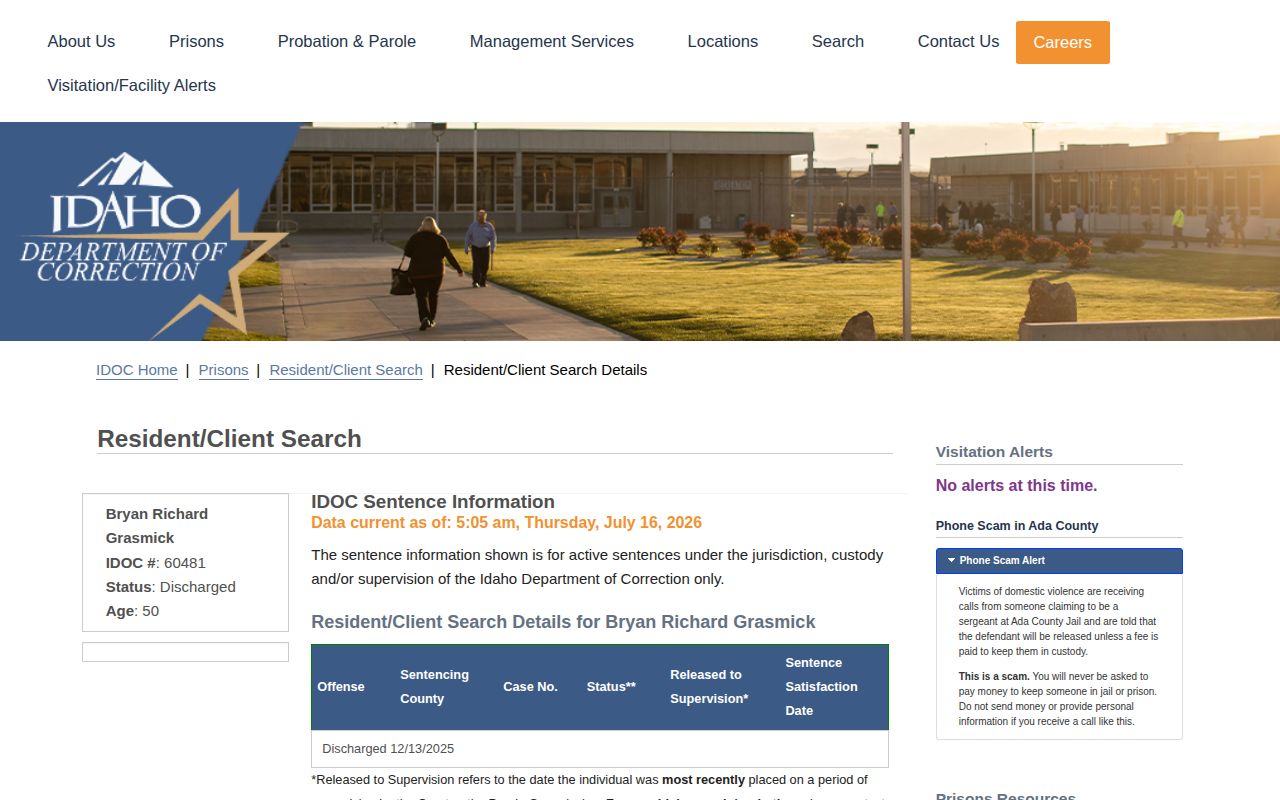
The displayed discharge date is meaningful within the state correctional system. It does not prove that the person physically exited Adams County Jail at that moment, nor does it rule out a separate local, federal, or immigration matter. When exact physical movement matters, pair the IDOC result with the releasing facility's record.
In Community Means Supervision
An official in-community example demonstrates the supervision fields available after an IDOC release.
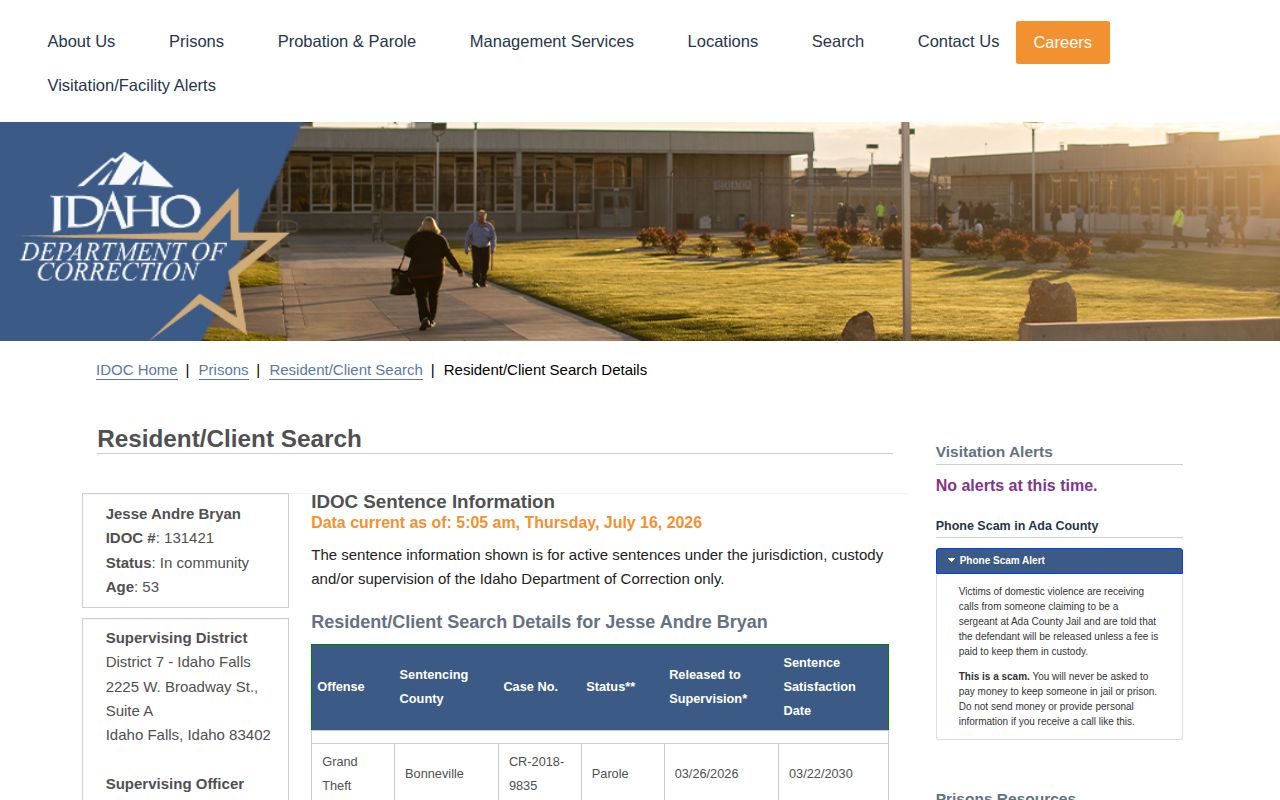
Released to Supervision means the most recent placement on supervision by a court or the Commission. It can reflect probation and is not automatically the date someone walked out of Adams County Jail. Sentence Satisfaction Date is the projected endpoint of the active sentence shown on the record. For Adams County clients, state parole and felony probation are served by IDOC District 3.
IDOC District 3 Contact
IDOC Probation and Parole District 3
3110 East Cleveland Boulevard, Building D
Caldwell, ID 83605
Phone: 208-454-7601
Fax: 208-454-7624
District 3 expressly covers Adams, Canyon, Gem, Owyhee, Payette, and Washington Counties. Published satellite offices are in Payette, Emmett, Homedale, and Middleton; no Council state-supervision satellite was listed. Call the Caldwell office when an In community
record is recent, ambiguous, or needs operational confirmation.
Adams County also publishes a local adult probation officer at the Council courthouse. Local court probation is not the same as IDOC parole or probation. The judgment and IDOC record identify the correct supervision authority. The Adams County Parole / Probation page compares both routes.
Contract Adams County Jail Beds
No state prison was found physically in Adams County. Even so, IDOC can report a current facility as Contract Adams County Jail 1
. That verified label shows why a small county jail can contain a person under state jurisdiction. Building location and legal custodian are separate questions.
A move from ordinary county custody into an IDOC contract bed is not a community release. If the state record remains In custody
, use IDOC for status, date fields, and later release evidence. The Sheriff may document the county-side transfer, while IDOC documents continued state custody. Those records describe consecutive parts of the same movement and should not be collapsed into one release event.
Contract Adams County Jail 1 is an IDOC custody location, not proof that Adams County contains a state prison.
Future Dates Are Not Releases
An active IDOC detail may display Parole Eligibility Date and Sentence Satisfaction Date. The first is an earliest opportunity for parole consideration, not an order. The second is the sentence endpoint shown by IDOC. A Tentative Parole Date comes from the Idaho Commission of Pardons and Parole and remains conditional on programming, plan approval, transportation, contract completion, and signature.
- Parole Eligibility Date
- The earliest ordinary point for parole consideration under the sentence structure.
- Tentative Parole Date
- A conditional Commission target that can change before actual release.
- Sentence Satisfaction Date
- The endpoint shown for the active IDOC sentence.
- Actual release evidence
- A status change such as In community with release-to-supervision detail, or a final Discharged status.
Idaho has no verified blanket rule that every person serves 85 percent, and ordinary compliance does not create routine good-time reduction from the judge-set fixed term. Use the Inmate Release Date page for the date calculation distinctions.
IDOC Records and VINE
For a state release document beyond the public detail, submit a narrow request to IDOC using the IDOC number, sentence or case when known, and the event fields or document sought. The Adams Sheriff is not the custodian of a state-prison discharge merely because an earlier booking happened locally. Court judgments and later discharge entries belong with the clerk.
Idaho VINE can deliver state custody notifications through phone, text, email, or available app options. Search the exact person and check the contributing agency before registering. A VINE message is timely notice, not a certified historical record, and a release from one contributor can be followed by another agency's custody. Save the notification details and confirm them with IDOC when exact authority or time matters.
For legal context, compare the IDOC record with iCourt. A sentence, amended judgment, probation order, or discharge entry can explain why status changed. When timestamps differ, record each source's capture time instead of assuming one system updates instantly.
Limits of an IDOC No-Result
The search retains former resident and client names after sentence satisfaction, making it useful for older state cases. Even so, no result is not proof that no custody or release occurred. A changed name, spelling variation, county-only case, another state's jurisdiction, or a person never placed under IDOC can explain the absence. Search identity variants, check the Adams court record, and reconstruct the custodial chain.
No resident portrait was verified in the IDOC pages reviewed for this project. A missing photo does not weaken a matched status record. IDOC number, birth year, case, sentencing county, exact status, and dates are the useful identifiers. A photograph from an earlier Adams County booking is a separate Sheriff record and may require a focused public-record request.
When a state result and court docket appear inconsistent, save both retrieval times. Contact the agency responsible for the disputed status instead of choosing one record by intuition. Daily updates, court entry timing, and transfer processing can produce short-lived differences.